

Select committees currently accepting written evidence (compiled 27 November 2024)
Please click the title of any inquiry listed below to be taken to a summary of that inquiry and the full call for evidence. Remember that you don’t have to answer every question posed in each call for evidence.
New calls for evidence launched since 27 November 2024:
- The Israeli-Palestinian conflict | Foreign Affair Committee | 31 December 2024
- The Financing of the Scottish Government | Scottish Affairs Committee | 5 January 2025
- Pensioner poverty – challenges and mitigations | Work and Pensions Committee | 6 January 2025
- Prison culture: governance, leadership and staffing | Justice and Home Affairs Committee | 10 January 2025
- Rehabilitation and resettlement: ending the cycle of reoffending | Justice Committee | 10 January 2025
- Children’s social care | Education Committee | TBC
- Social media, misinformation and harmful algorithms | Science, Innovation and Technology Committee | TBC
All inquiries currently accepting written evidence:
- FCA and PRA’s secondary competitiveness and growth objective | Financial Services Regulation Committee | 29 November 2024
- Acceptance of Cash | Treasury Committee | 2 December 2024
- HS2: Update following Northern leg cancellation | Public Accounts Committee | 5 December 2024
- Tax evasion in the retail sector | Public Accounts Committee | 5 December 2024
- Make Work Pay: Employment Rights Bill | Business and Trade Committee | 6 December 2024
- In Development: call for potential topics of inquiry | International Development Committee | 9 December 2024
- Summer 2024 disorder | Home Affairs Committee | 10 December 2024
- Adult Social Care Reform: The Cost of Inaction | Health and Social Care Committee | 11 December 2024
- Environmental sustainability and housing growth | Environmental Audit Committee | 20 December 2024
- Property (Digital Assets etc) Bill | Lords Special Public Bill Committee | 20 December 2024
- The work of the Committee | Modernisation Committee | 16 December 2024
- Improving educational outcomes for disadvantaged children | Public Accounts Committee | 31 December 2024
- The FCDO’s approach to value for money | International Development Committee | 7 January 2025
- Unlocking community energy at scale | Energy Security and Net Zero Committee | 13 January 2025
- Workforce planning to deliver clean, secure energy | Energy Security and Net Zero Committee | 13 January 2025
- Promoting Wales for inward investment | Welsh Affairs Committee | 13 January 2025
- Crown Court backlogs | Public Accounts Committee | TBC
- DCMS management of COVID-19 loans | Public Accounts Committee | TBC
- Decommissioning Sellafield | Public Accounts Committee | TBC
- Driving tests availability | Transport Committee | TBC
- Prison estate capacity | Public Accounts Committee | TBC
- The Remediation of Dangerous Cladding | Public Accounts Committee | TBC
- Use of AI in Government | Public Accounts Committee | TBC
- Whole of Government Accounts 2022-23 | Public Accounts Committee | TBC
Why should I engage? Submitting evidence to a select committee can lead to further engagement, such as an invitation to give oral evidence. Your submission will be published on the Committee webpage. Your insights may inform the Committee’s conclusions or the recommendations it makes to the Government. Find out more about why to engage with Parliament. You can also read more on engagement for impact.
More information: Explore all select committee inquiries currently open for submissions of written evidence.
Resources: Find guidance on submitting evidence to select committees on the KEU’s ‘how to guides’ page. Watch our 30 minute online training session “How to work with select committees”
Call for interdisciplinary research evidence on adult social care reform
As you may have spotted above, the Health and Social Care Committee has opened an inquiry into the adult social care reform and the cost of inaction. The Committee is keen to hear from a range of research perspectives during this inquiry, including on:
- The cost to HM Treasury and the economy
- The impact on employment and people out of work due to care support needs
- The impact of increased caring responsibilities on employment
- Measuring quality of life in older people and disabled people, and how this is impacted by accessing social care
- Any other relevant research on this topic
If you have expertise on this topic, we encourage you to consider submitting evidence to this inquiry.
You can read more about the inquiry and how to submit written evidence here. Remember that you don’t have to answer every question posed in the call for evidence. You can submit evidence until Wednesday 11 December 2024.
Meet Parliament’s Thematic Research Leads: Dr Varuna De Silva (AI and digital)
In this new feature we’ll introduce you to one of our eight Thematic Research Leads (TRLs) each week.
Since 2023 Parliament and UKRI have partnered to bring in two groups of mid-career researchers to support Parliament’s research engagement in identified thematic areas. The TRLs join us in parliament for three days per week whilst maintaining their substantive research role during the rest of their working week. TRLs provide:
- strategic support for the production and delivery of research evidence for Parliament, within a broad policy area
- activities to support the development of a research and innovation landscape that facilitates and encourages knowledge exchange between Parliament and the research community.
- participate in a network of Thematic Research Leads to share intelligence and insights across policy areas and support collaborative approaches to policy.
This week we’re featuring Dr Varuna De Silva, the Thematic Research Lead for AI and digital.

Dr Varuna De Silva is a Reader in Machine Intelligence and Digital Technologies at Loughborough University. He has a PhD in digital signal processing from University of Surrey. Prior to joining academia, he worked as a senior research engineer in the consumer electronics industry, and the telecommunications industry. As a post-doctoral researcher, he contributed to two major EU funded projects. He is the recipient of two major research awards from EPSRC/UKRI for next generation AI development for Sports Analytics and Autonomous Drone Systems design. He has worked closely with Chelsea F.C. Academy, Dallas Mavericks NBA team, and Toyota manufacturing-UK to translate his research to real world applications. His current work on trustworthy autonomous systems, in collaboration with defence stakeholders of the UK, seeks to triage wounded soldiers in battlefields through drones. Varuna directs the machine intelligence lab at Loughborough University London, with a vision to scale state-of-the-art AI algorithms to real world, sustainable, trustworthy, engineering systems. He is the founder and director of a successful Masters in AI and Data analytics programme at Loughborough University.
As TRL for AI and digital Varuna is based within the Science, Digital and Technology Hub part of the Research and Information and Select Committee teams. Since joining us as a TRL, he is developing an AI reading list for Science, Digital and Technology Hub, has contributed on improving the AI training guide for MP’s, and has supported the Public Accounts Committee on providing relevant witnesses to consult about the use of AI in procurement.
Varuna is keen to hear about AI and digital research which may be of interest to Parliament. If you would like to introduce yourself and your research to Varuna, please fill out this form. Varuna may not be able to respond to all introductions. However, please know your contact has been received and is valued. Varuna will note your expertise area and store your contact details in line with our privacy policy ready to get in touch when Parliament is focussing on your research topic.
Thank you to everyone who has already introduced their research to Varuna. If you filled out the form we shared previously, there is no need to resubmit your details.
Why should I engage? Thematic Research Leads (TRLs) are prestigious and influential roles, designed in partnership with UKRI to facilitate and enhance the use of research evidence and expertise in Parliament through effective knowledge exchange and collaboration. Introducing yourself to the new TRLs is a great opportunity to be involved in their work.
More information: Find out more about our Thematic Research Lead programme. Read about the work of our first cohort of TRLs:
- Professor Kristen Harkness (international affairs and defense)
- Professor Rick Whitaker (parliament, public administration and constitution)
- Professor Tamsin Edwards (climate and environment)
Register for a Senedd ARI
Areas of Research Interest (ARIs) are lists of policy issues or questions. They are a way for an organisation to express interest in seeing more research evidence in certain topics.
Senedd committees issue calls for evidence based on their current priorities – ARIs do not replace these calls for evidence. However, ARIs may be used by Members of the Senedd and by Senedd staff to scope and/or inform future work, identify witnesses, and gather research evidence to support scrutiny.
Our colleagues in the Senedd have recently opened two new Areas of Research Interest (ARIs) on:
- Artificial Intelligence (AI) and the Welsh Economy (from the Economy, Trade, and Rural Affairs Committee)
- Environmental Governance, Principles and Biodiversity Targets (from the Climate Change, Environment, and Infrastructure Committee)
The Senedd currently also has ARIs open on:
- Innovation for improvement in healthcare (from the Health and Social Care Committee)
- Disability employment gap (from the Equality and Social Justice Committee)
- Behaviour change in response to the climate emergency (from the Climate Change, Environment, and Infrastructure Committee)
- Modal shift and active travel (from the Climate Change, Environment, and Infrastructure Committee)
- Sustainable communities (from the Climate Change, Environment, and Infrastructure Committee)
If you have evidence or insights on the ARIs (including evidence reviews), you can add information about the research and your contact details to the repository of research. If this area becomes a topic of scrutiny within the Senedd, staff may search the repository for relevant research and contacts.
You can read more about how to engage with these ARIs on the Senedd website.
Why should I engage? Parliament for Researchers with the House of Lords training sessions offer a unique opportunity to learn more about the UK Parliament and how it uses research from the perspective of a Member of the House of Lords. The sessions also contain practical information and advice on how to engage with Parliament as a researcher, including details on select committees, the House of Commons and House of Lords Libraries, POST, and working with individual Parliamentarians.
More information: Find out about upcoming sessions and how to sign up here. You can also find recordings of previous training sessions here.
Reminders: shared in a previous round-up
Some of the opportunities we’ve shared in previous round-ups are still open:
- Apply to become a Committee Specialist in the Science, Innovation and Technology Committee team by Sunday 1 December
- Register to attend our Parliament for Researchers session with Baroness Harding on the theme of AI and digital on Tuesday 17 December, 13:00-14:00.
Mapping global parliamentary mechanisms for accessing academic research
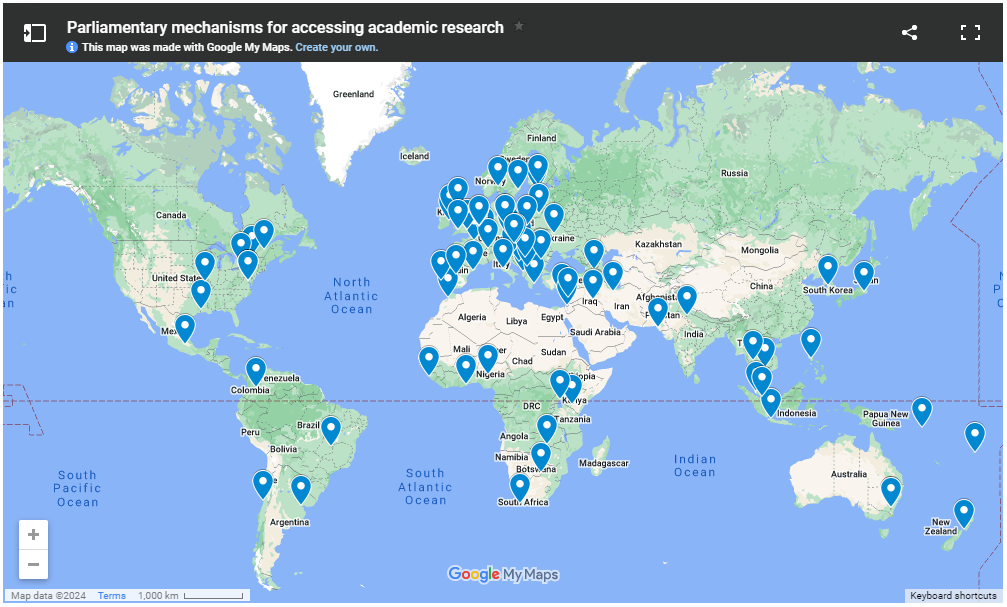
Hear from Dr Vicky Ward and Professor Mark Monaghan on their Parliamentary Academic Fellowship project mapping mechanisms for accessing academic research in parliaments around the world:
Parliamentary libraries and research services are found around the world but their role is often under-appreciated. Research suggests that around 90% of legislatures lack effective science advice mechanisms, and that the most recognised libraries and research services are found in northern European democracies.
We wanted to find out more about how research is used in parliaments around the world. We hosted knowledge exchange events with parliamentary services from around the world, including workshops with the AGORA Parliamentary Development Community of Practice.
So What?
Our project showed a different picture of the parliamentary research landscape. Our findings showed that there were effective and modern research services helping parliaments to harness research evidence across the world, not just in northern Europe.
Through this project, we’ve also been able to stay in touch with parliamentary research organisations around the world, sharing knowledge and highlighting areas of best practice.
More information:
- Explore the global mapping of parliamentary mechanisms for accessing academic research
- Read an article on this research: Bridging the gap between research and parliament: An examination of parliamentary mechanisms for engaging with academic research
Note on this round-up
If you have been forwarded this email and would like to get it yourself, you can subscribe directly to receive our weekly email round-up of opportunities for the research community to engage with UK Parliament. These opportunities can include calls for evidence from select committees, academic fellowship opportunities, requests for expertise from Parliament and more. You will receive the round-up each week, with some exceptions such as parliamentary recess.
If you consider yourself a knowledge mobiliser, find out how to join our informal network of knowledge mobilisers. This is a network of people whose role includes sharing research from their institution with other sectors, or supporting researchers to share their research.
 Research and Innovation